




Harnessing Terahertz Waves: Advancements in Non-Destructive Testing Applications
Authors: Jyotirmayee Dash, Lenin B, Desh Praveen Kumar, Ruban Raj, Shyamsunder Mandayam, and Bala Pesala.
Published Online: June 2024
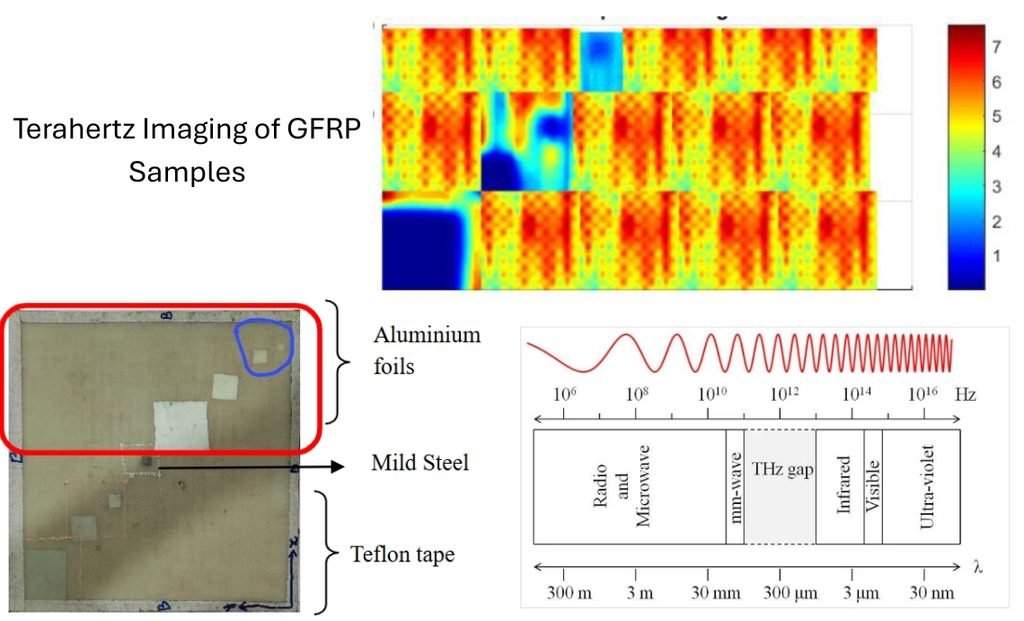
Abstract: Terahertz (THz) technology has established itself as an effective non-destructive technique for the detection of various materials. Over the last decade, the effectiveness and accuracy of this technology havebeen demonstrated extensively in various applications starting from structural health monitoring, quality controlto non-destructive testing. The THz industry is rapidly moving towards a more customized,rugged, turnkeyTHz systemsthatcan be used in various industrial applications. This article presents acomprehensive overview of non-destructive testing applications of THz imaging and spectroscopy. It also explains the fundamentals of Terahertz radiation and its applicability in various real-worldscenarios such as coating thickness, detection of internal defects, debonds and delamination of composites, quality monitoring in pharmaceutical tablets,defect detection of electronic componentsetc. This paper also discusses the challenges deployingcurrent THz systems in the real-world applications and way forward to overcome these challenges.
Disclaimer: All experimental results, figures, and methodology are in the full paper published in JNDE, Vol. 21, Issue 2, June 2024.
Latest publications
- Ultra-Broadband Terahertz Flexible Meta-Absorber
- Role of structural asymmetry in tailoring electromagnetically induced transparency and figure of merit in terahertz metamaterials
- Understanding Terahertz Waves: The Science, Applications & Technology
- Identification of adulterants in turmeric powder using terahertz spectroscopy
- Design and Engineering of Organic Molecules for Customizable Terahertz Tags
- Terahertz Spectroscopy and Solid-State Density Functional Theory Calculations of Cyanobenzaldehyde Isomers
- Comparative Study of Hydration Kinetics of Cement and Tricalcium Silicate Using Terahertz Spectroscopy and Density Functional Theory Simulations