TeraLumen Solutions

Terahertz Technology

 
Customer Portal

Thermal Barrier Coating Thickness on Carbon Fibre Reinforced Plastic (TBC on CFRP)

A new method to monitor quality TBC on CFRP.

Challenge: In the Growing Use of Composites in Aerospace(TBC on CFRP)

In today’s aerospace and space sector, the carbon fibre-reinforced plastics (TBC on CFRP) plays a vital role because of its efficient properties such as high specific strength and stiffness, good fatigue, and chemical resistance which are much need for structures integrity. The majority of commercial airplanes are from Boeing 737, 747, 777, 787 and Airbus A320, A330, A350, A380. The goal of the International Civil Aviation Organization (ICAO) is to reduce aviation emissions by at least 50% by 2050. So, the development of composites with lightweight materials, namely CFRP, will increase. The modern aircrafts like Boeing 787 and Airbus A380 use more than 50% of CFRP in aircraft structures. To fully utilize on CFRP benefits under which thermal protection is crucial. The polymer matrix, which binds with the carbon fibers are vulnerable to heat-induced decomposition. Safeguarding CFRP from high temperatures and frictional forces are vital. CFRP is now being an integral part of advanced satellites, launch vehicles, and space exploration missions which will also need to sustain from drastic temperatures and frictional forces.

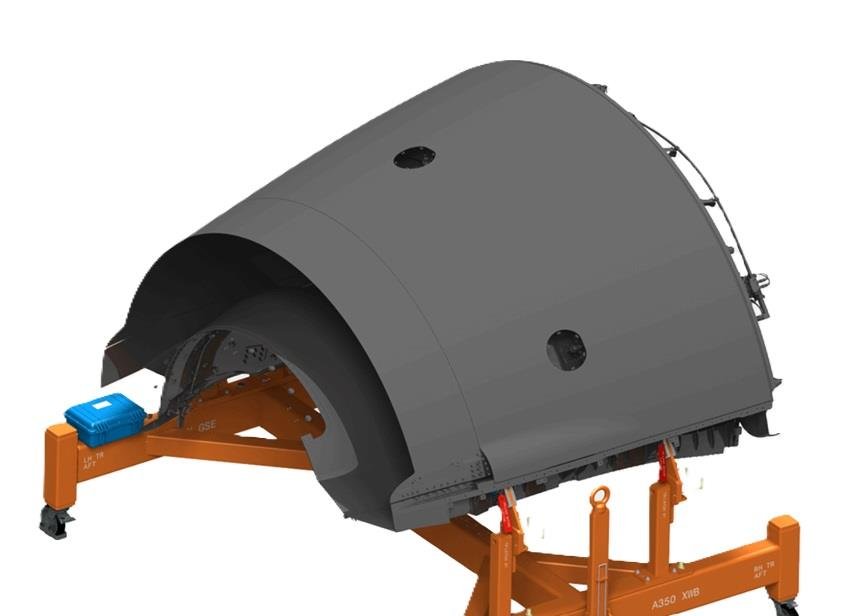
Traditionally, thermal barrier coatings (TBCs) shield metallic components in aerospace nacelle / thrust reversers from extreme heat, but their application to carbon fiber reinforced polymers (CFRPs) is a burgeoning field. Currently, research and development focus on understanding the long term performance of high-temperature resistant coatings on CFRPs under diverse operational conditions, including thermal cycling, humidity, and chemical exposure. This advancements in TBC technology for CFRP structures bring unique challenges on monitoring its thickness and coating bodings to optimize thermal insulation and minimize stress concentrations, thereby enhancing the component lifespan and overall reliability of composite materials in demanding environments. This evolution of thermal protection is crucial for advancing the use of CFRPs in next-generation applications.

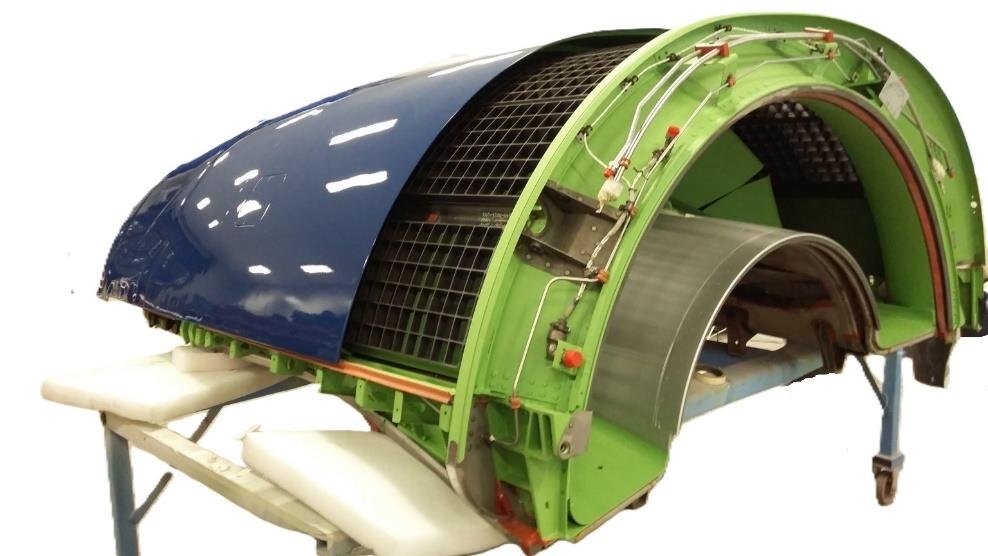
TBC on CFRP : A Thrust Reverser with Thermal Barrier Coating on Metallic Surface

Solution: Why Terahertz Now?

To understand the growing adoption of Terahertz (THz) technology, it’s essential to see the limitations of previous methods. Traditionally, thermal barrier coatings (TBCs) on metallic structures were often inspected using Eddy Current Testing (ECT) and other electromagnetic Non-Destructive Testing (NDT) techniques. These methods are effective for conductive materials, primarily ferrous and non-ferrous metals, and can provide information about TBC quality on those materials.

Aerospace manufacturers are continuously seeking ways to improve fuel efficiency and performance, driving the adoption of advanced materials. As a recent example from aerospace, the Jet Engine Nacelles/Thrust Reversers are located around the engine and therefore exposed to hot exhaust gases, engine heat and aerodynamic heat. Steel, Aluminium and Titanium and widely used due to high strength-to-weight ratio. Some pioneer industries working towards replacing these thrust reversers with Thermal Barrier Coated CFRP’s which directly leads to significant fuel efficiency.

With the increasing use of Carbon Fiber Reinforced Polymer (CFRP) in aerospace for weight reduction and performance improvements, a new challenge emerged. CFRP is significantly less conductive than metals and its conductivity is highly anisotropic. Therefore, conventional NDT techniques like Eddy Current Testing (ECT) and other electromagnetic methods are not effective for inspecting TBC thickness, density and bonding on CFRP.

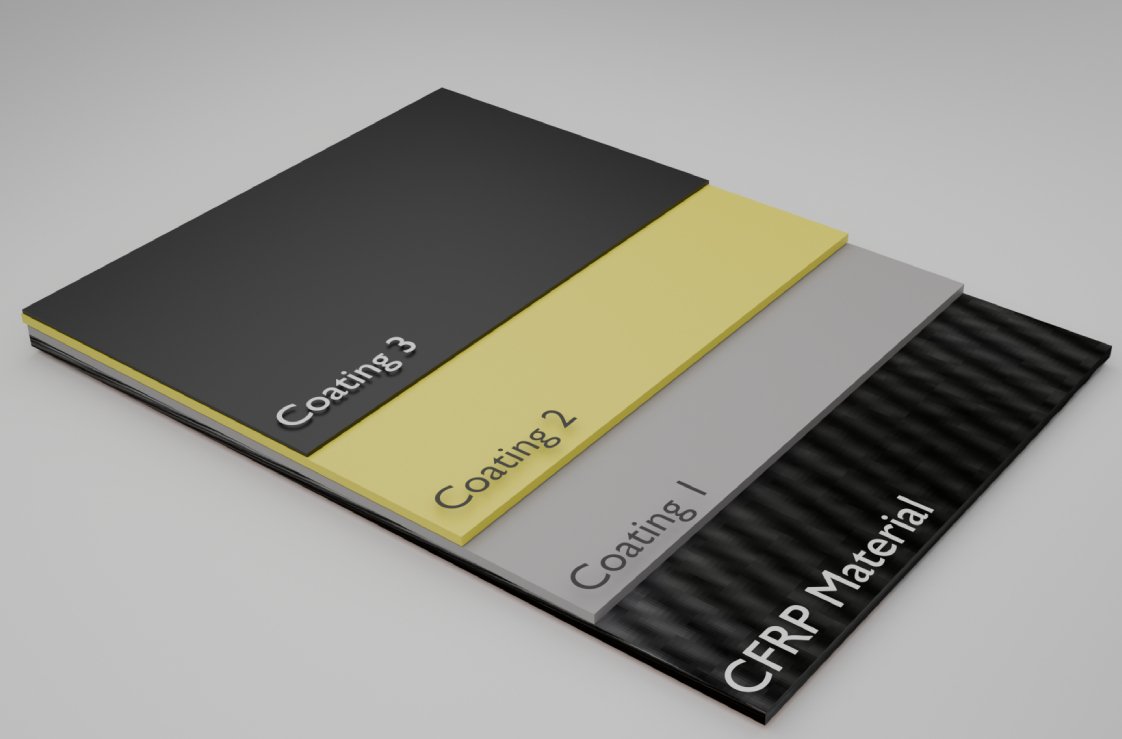
TBC on CFRP

Conclusion: A new method to measure TBC on CFRP

To address the limitations of traditional non-destructive testing (NDT), researchers have increasingly explored alternative technologies such as air-coupled ultrasonics, microwaves, and, notably, terahertz (THz) imaging. Terahertz technology, with its non-ionizing nature and non-contact testing capabilities, has demonstrated promising results in the quality control of advanced composite materials. Specifically, THz imaging’s ability to accurately measure thickness and detect sub-surface defects in single-layer and multi-layer thermal barrier coatings (TBCs) on carbon fiber reinforced polymer (CFRP) components, where the coating material’s refractive index ranges from 1.4 to 2.5, makes it a valuable tool for ensuring the structural integrity and reliability of these materials in emerging industries like aerospace and automotive, contributing to improved manufacturing processes and enhanced material characterization.

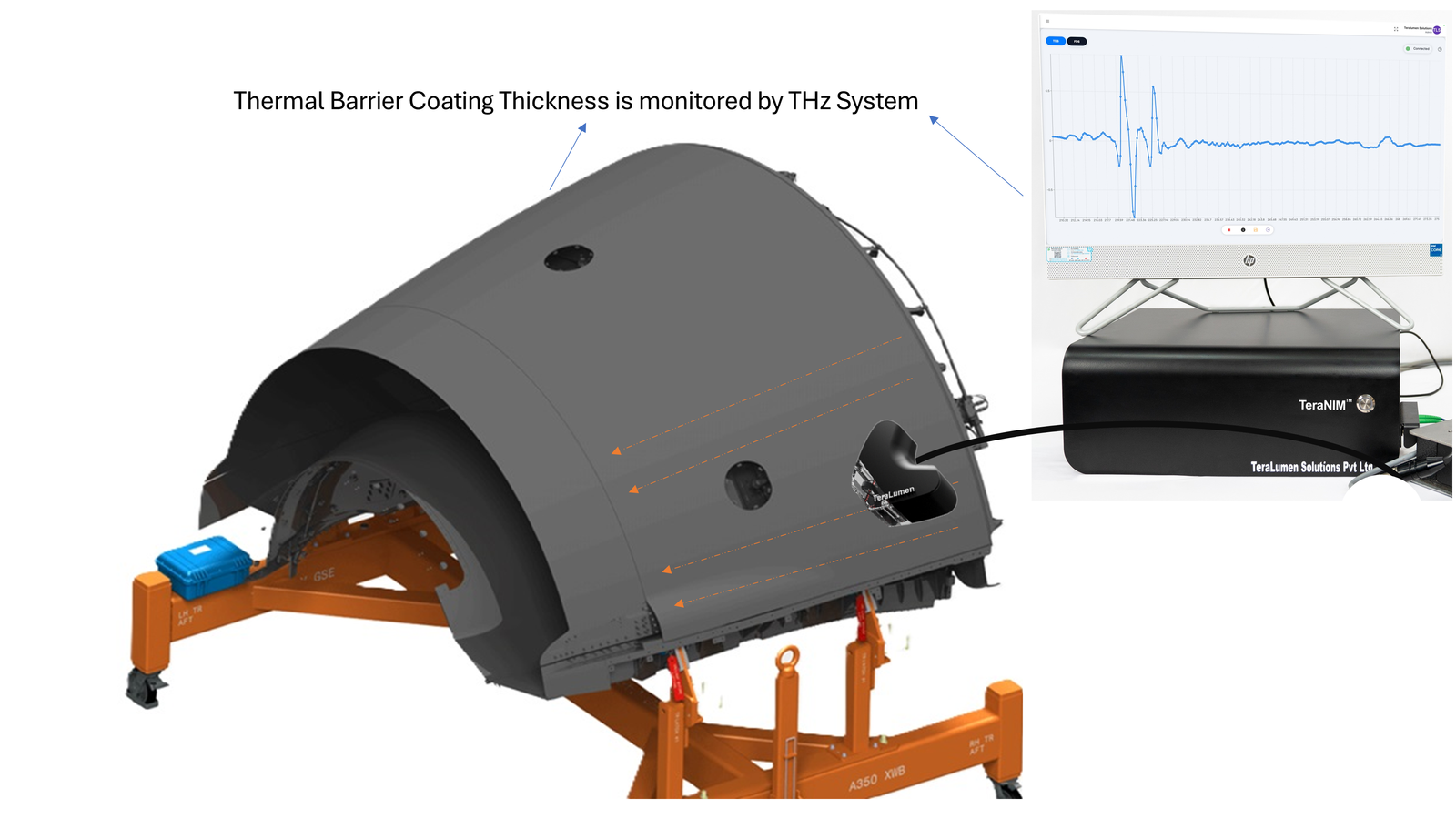
TeraNIM – A Compact and Industrial Terahertz NDT System with 0.1 to 3.5 THz frequency bandwidth successfully measures TBC thickness on CFRP substrates. Thanks to non-contact testing, bring advantage to test and measure inaccessible areas in complex geometric CFRP parts. Terahertz Technology uniquely capable to measure TBC Thickness, Detect Defect and Density in single scan.

Key Benefits:

  • Real-Time Results
  • Micron Level Thickness Accuracy
  • Feasible for Manual or Automated Measurements
  • Capable 24×7 measurements
  • Multi-Layer Thickness Measurements
    Defect Detection inImaging
  • Integrated Camera to visualize measuring location
TBC on CFRP

Key Benefits:

  • Real-Time Results
  • Micron Level Thickness Accuracy
  • Feasible for Manual or Automated Measurements
  • Capable 24×7 measurements
  • Multi-Layer Thickness Measurements
    Defect Detection inImaging
  • Integrated Camera to visualize measuring location

In today’s aerospace and space sector, the carbon fibre-reinforced plastics (CFRPs) plays a vital role because of its efficient properties such as high specific strength and stiffness, good fatigue, and chemical resistance which are much need for structures integrity. The majority of commercial airplanes are from Boeing 737, 747, 777, 787 and Airbus A320, A330, A350, A380. The goal of the International Civil Aviation Organization (ICAO) is to reduce aviation emissions by at least 50% by 2050. So, the development of composites with lightweight materials, namely CFRP, will increase. The modern aircrafts like Boeing 787 and Airbus A380 use more than 50% of CFRP in aircraft structures. To fully utilize on CFRP benefits under which thermal protection is crucial. The polymer matrix, which binds with the carbon fibers are vulnerable to heat-induced decomposition. Safeguarding CFRP from high temperatures and frictional forces are vital. CFRP is now being an integral part of advanced satellites, launch vehicles, and space exploration missions which will also need to sustain from drastic temperatures and frictional forces.

Traditionally, thermal barrier coatings (TBCs) shield metallic components in aerospace nacelle / thrust reversers from extreme heat, but their application to carbon fiber reinforced polymers (CFRPs) is a burgeoning field. Currently, research and development focus on understanding the long term performance of high-temperature resistant coatings on CFRPs under diverse operational conditions, including thermal cycling, humidity, and chemical exposure. This advancements in TBC technology for CFRP structures bring unique challenges on monitoring its thickness and coating bodings to optimize thermal insulation and minimize stress concentrations, thereby enhancing the component lifespan and overall reliability of composite materials in demanding environments. This evolution of thermal protection is crucial for advancing the use of CFRPs in next-generation applications.

Thermal Barrier Coating Thickness on CFRP with Terahertz NDT

Thermal Barrier Coating
Thickness Measurement on CFRP

Terahertz Technology for Non-Contact Thermal Barrier Coating
Thickness Measurement on Aerospace CFRP Components.

Aerospace composite manufacturing and thermal-protection programs involve CFRP structures, complex geometries, curved surfaces and tightly controlled coating processes where thermal barrier coating thickness and uniformity are important for protecting the underlying composite.

TeraNIM-Aero helps measure Thermal Barrier Coating (TBC) thickness on CFRP non-destructively and without physical contact, enabling aerospace OEMs and research teams to reduce routine destructive cross-section checks and build a digital coating-thickness inspection workflow for CFRP panels, thermal-protection structures, composite housings, fairings and other coated aerospace components.

Conventional Aerospace Coating Thickness Measurement Challenges

Cross-Section Microscopy
Destructive, Laboratory-Based
Ultrasonic Testing
Contact-Based, Couplant Required
Curved CFRP Structures
Non-Metallic Composite Substrate
  • Non-metallic CFRP substrate
  • Curved aerospace structures
  • Coating-specific properties
  • Large-area thickness verification
  • Need for non-contact inspection

How Terahertz Technology Works for TBC Thickness on CFRP

TeraLumen's patented Terahertz Technology System generates THz waves from 0.1 to 5THz bandwidth. TeraNIM-Aero directs a THz pulse onto the coated CFRP surface and detects reflections at the air/TBC surface and the TBC/CFRP interface. When sufficient dielectric contrast exists between the coating and the composite substrate, the time delay between these reflections is analysed using the calibrated refractive index of the coating to calculate the thermal barrier coating thickness.

AirTBC SurfaceTBC / CFRP InterfaceCFRP Substrate

TeraNIM Aerospace Inspection Workflow

SCAN
Scan the CFRP Component
  • Position the TeraNIM-Aero probe above the coated CFRP component
  • Non-contact, single-sided measurement
  • Point or automated scanning at defined inspection locations
DETECT
Detect Interface Reflections
  • Identify the air/TBC surface reflection
  • Identify the TBC/CFRP interface reflection
  • Measure the time delay between these reflections
  • Time delay provides the information needed to determine coating thickness
REPORT
Analyse & Report
  • TBC Thickness
  • Thickness Variation
  • Thickness Mapping
  • Pass / Fail Result
  • Digital Measurement Record
  • Results can be stored digitally for comparison, reporting and coating-uniformity analysis.
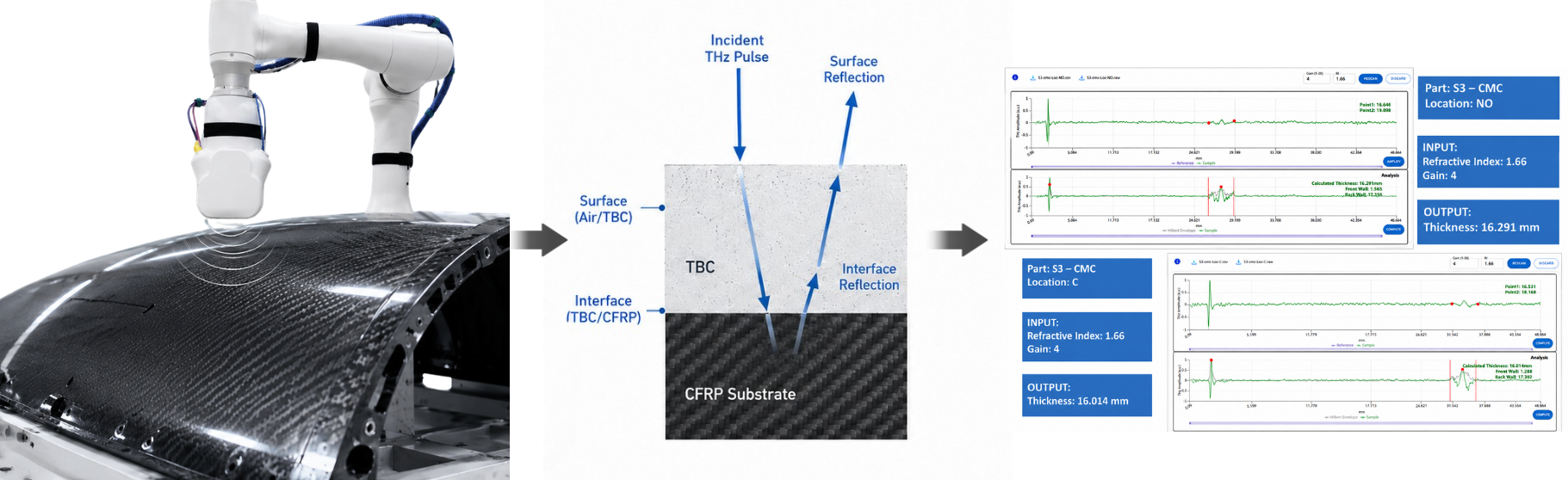
Terahertz inspection workflow diagram for TBC on CFRP

Key Advantages to Aerospace OEMs & Research Organisations

  • Non-Contact Inspection – No physical probe contact with the thermal barrier coating.
  • Non-Destructive Measurement – TBC thickness evaluated without cutting or sectioning the CFRP component.
  • Single-Sided Access – Inspection performed from the coated side of the aerospace component.
  • Thickness Mapping – Multiple measurement locations identify coating-thickness variation across the component.
  • Automation Ready – Can be integrated with scanners, robots or cobots for repeatable inspection of larger or curved aerospace structures.
Terahertz inspection workflow diagram for TBC on CFRP

Aerospace TBC Quality Control with TeraNIM™

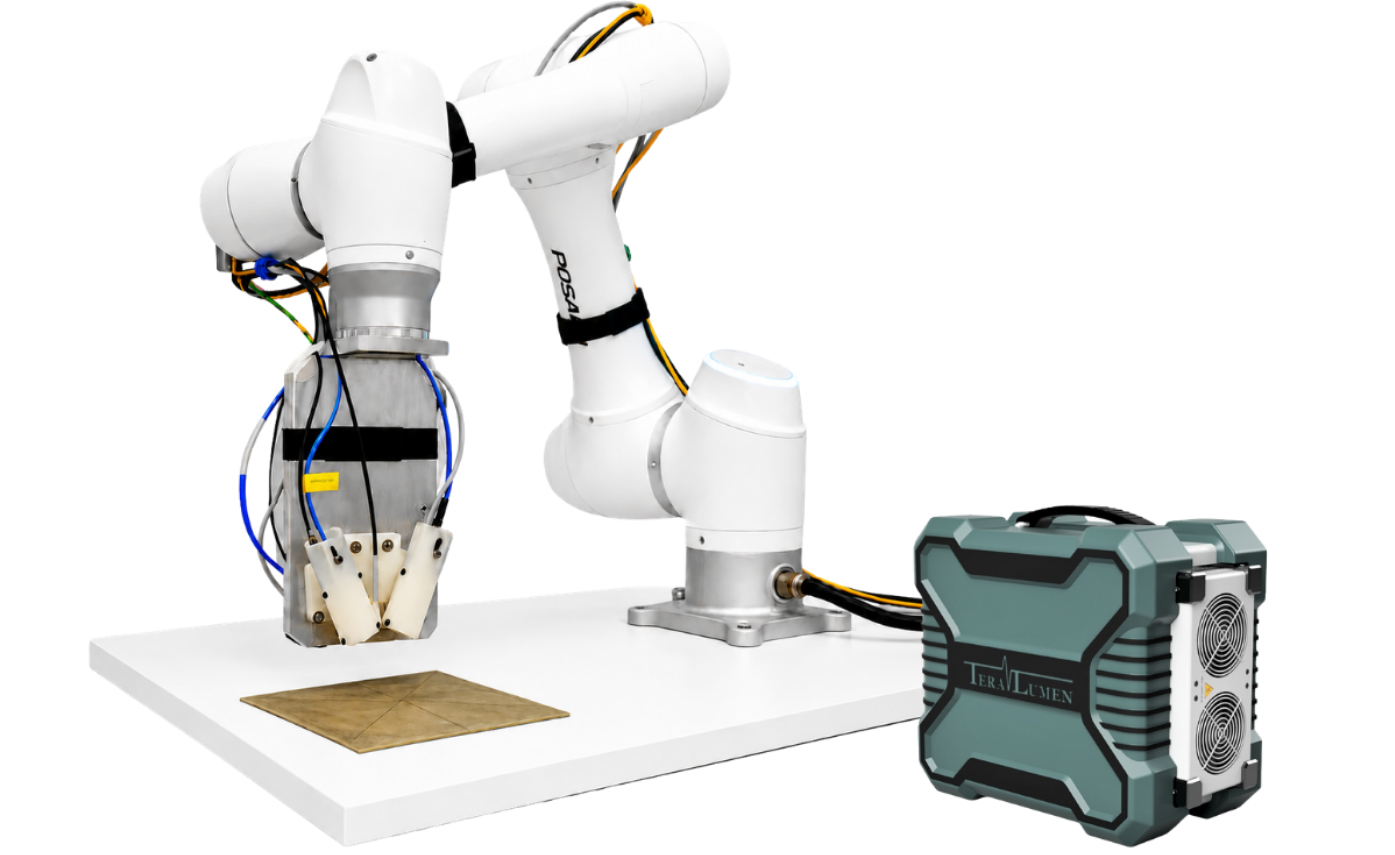
TeraNIM-Aero provides a non-contact and non-destructive approach for Thermal Barrier Coating thickness measurement on validated CFRP components. By combining THz reflection measurement, coating-specific calibration and digital analysis, the system can support TBC thickness verification, coating-uniformity assessment, thickness mapping and automated aerospace quality control.
Frequently Asked Questions

Can THz measure Thermal Barrier Coating thickness on CFRP?

Yes. For suitable and validated TBC/CFRP material systems, TeraNIM-Aero can use reflected THz signals to determine coating thickness without damaging the component.

Does the THz probe need to contact the coating surface?

No. TeraNIM-Aero performs the measurement non-contact, which is useful for sensitive coatings and automated aerospace inspection.

Can TeraNIM-Aero inspect curved CFRP components?

Yes. Curved components can be inspected, provided the probe position, stand-off distance and orientation are controlled relative to the local surface.

Is calibration required for different TBC materials?

Yes. Different coating materials can have different refractive indices and THz responses, so calibration using a representative reference sample is recommended for each coating system.

Can TeraNIM-Aero generate a TBC thickness map?

Yes. Measurements taken at multiple points across the component can be combined to show coating-thickness distribution and local variation.

Can THz completely replace destructive cross-section microscopy?

Not completely. Cross-section microscopy remains useful as a reference method during initial calibration and validation. After validation, TeraNIM-Aero can reduce the need for routine destructive thickness checks.