
















GFRP Composite
Inspection
Terahertz Technology for Non-Contact GFRP Thickness Measurement
and Internal Defect Detection.
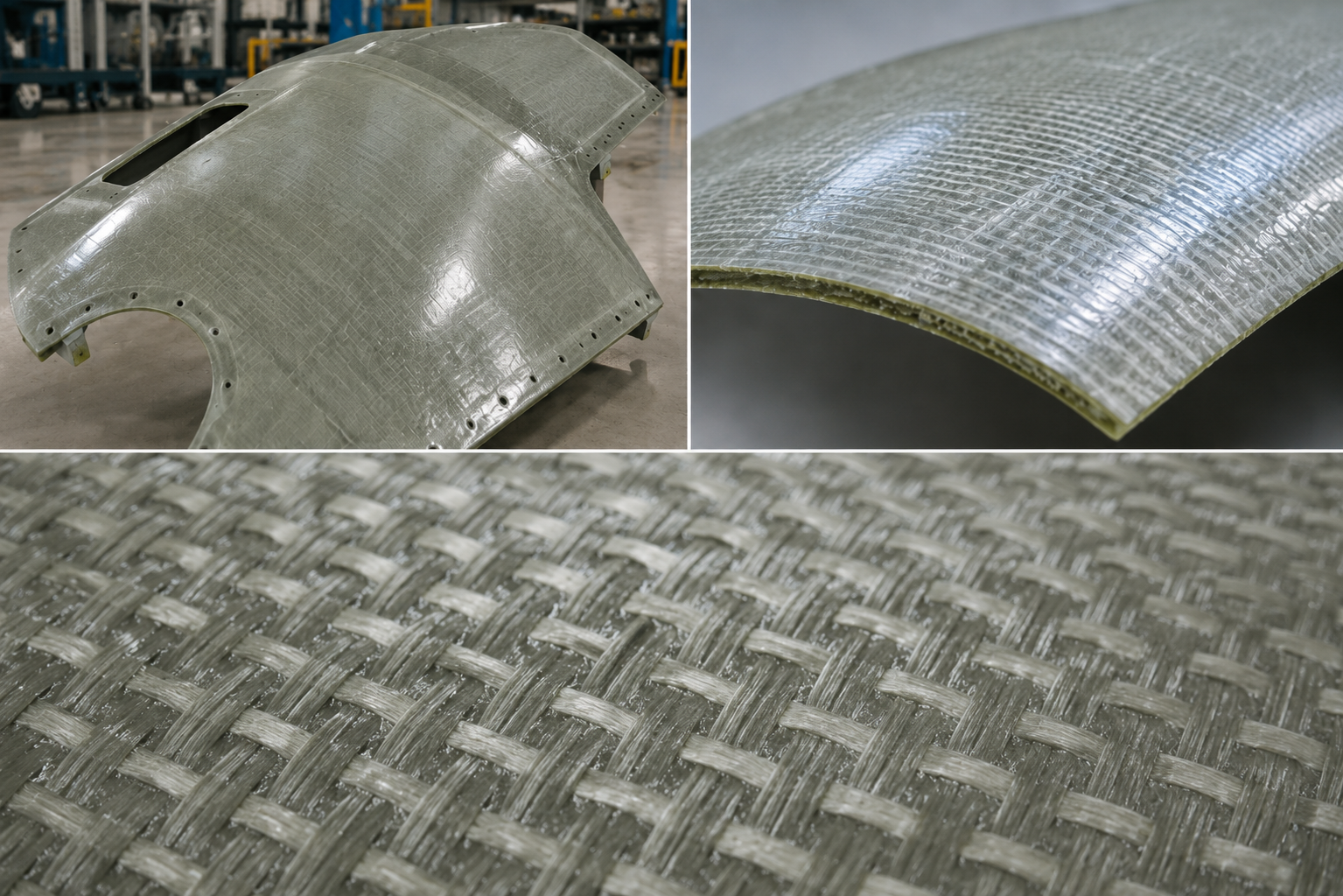
Glass Fibre Reinforced Plastic (GFRP) inspection is important for aerospace components where lightweight construction, corrosion resistance and structural reliability are critical. During manufacturing and service, hidden defects such as delamination, voids, inclusions and layer-thickness variations can develop inside the laminate.
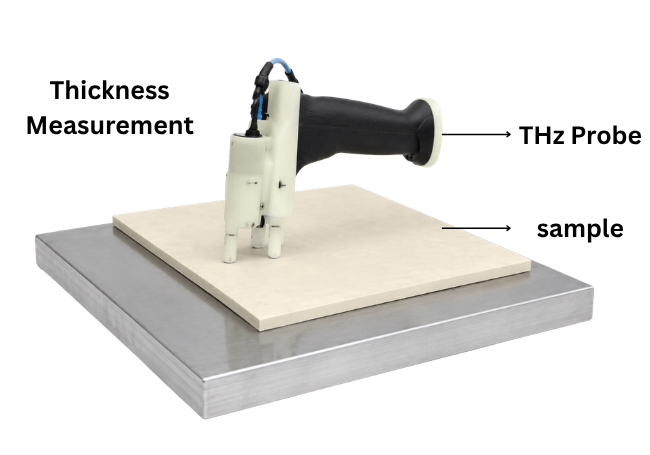
TeraNIM-Aero uses Terahertz Time-Domain Spectroscopy (THz-TDS) for non-contact, non-destructive GFRP inspection, enabling evaluation of material thickness, internal interfaces and subsurface defects without cutting the component or using liquid couplants, for aerospace parts such as radomes, fairings, fins, rudders, leading-edge structures and access panels.
Why GFRP Needs Non-Contact Inspection?
- Layered dielectric structure with many internal interfaces
- Delamination hidden at unknown depth in the stack
- Voids, air gaps and foreign inclusions from layup and cure
- Thickness variation across large or curved panels
- Single-sided access on assembled aerospace structures
Conventional GFRP Inspection Challenges
- Contact-based inspection
- Requires couplant or component preparation
- Difficult access on large or complex structures
- CT can be costly and difficult to deploy for large components
- Sectioning is destructive
How Terahertz Technology Works for GFRP Inspection
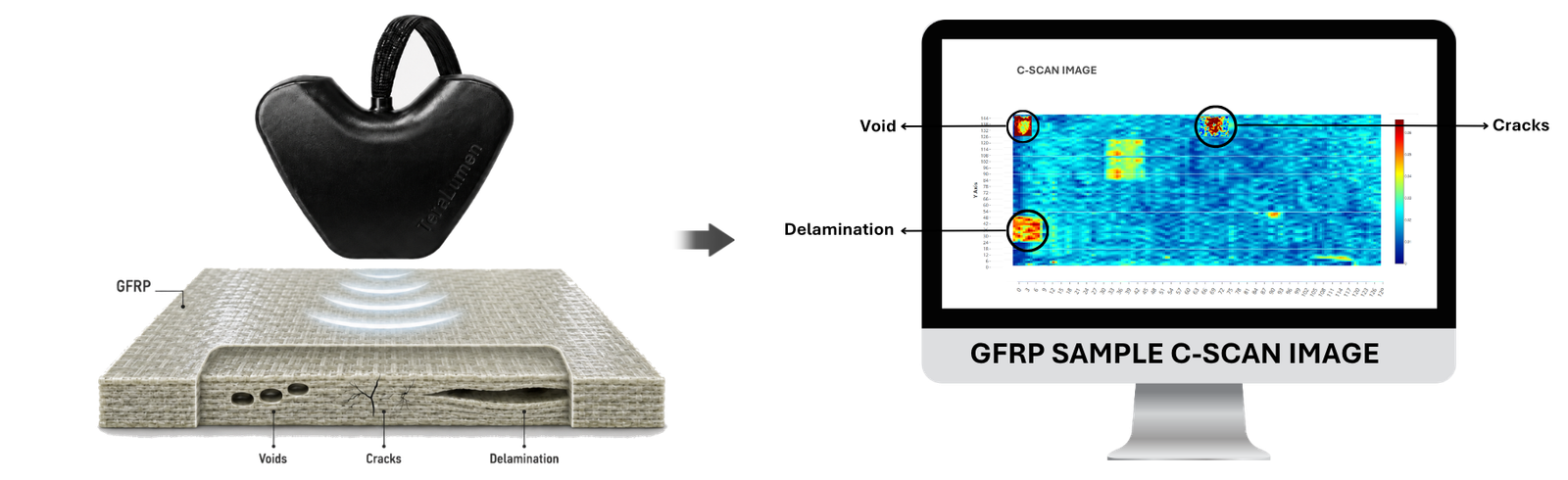
TeraLumen's Terahertz Technology System generates THz waves that penetrate dielectric composites and reflect at every interface with sufficient dielectric contrast. The time separation between those reflections carries the optical thickness of the material between them. A delamination or air gap adds an extra interface to this path — the additional reflection, and its arrival time, makes the defect both detectable and locatable in depth. A proprietary signal-processing model deconvolutes overlapping reflections so individual laminate features resolve on calibrated structures.
TeraNIM Aerospace GFRP Inspection Workflow
Direct a THz pulse onto the GFRP aerospace component and acquire reflected signals across the defined inspection area using single-side, non-contact scanning.
Identify reflections and signal changes associated with laminate interfaces and internal discontinuities such as delamination, voids, inclusions and thickness variation.
Determine laminate thickness, defect location and depth indications, generate a 2D B-scan / C-scan inspection map, and provide the Pass / Fail inspection result.
Key Advantages for Aerospace OEMs
- Non-Contact – No probe contact, no couplant.
- Non-Destructive – No cutting or sectioning of the laminate.
- Delamination Detection – Internal delamination alters the reflected THz signal.
- Thickness & Defect Mapping – Thickness data and spatial maps of indications.
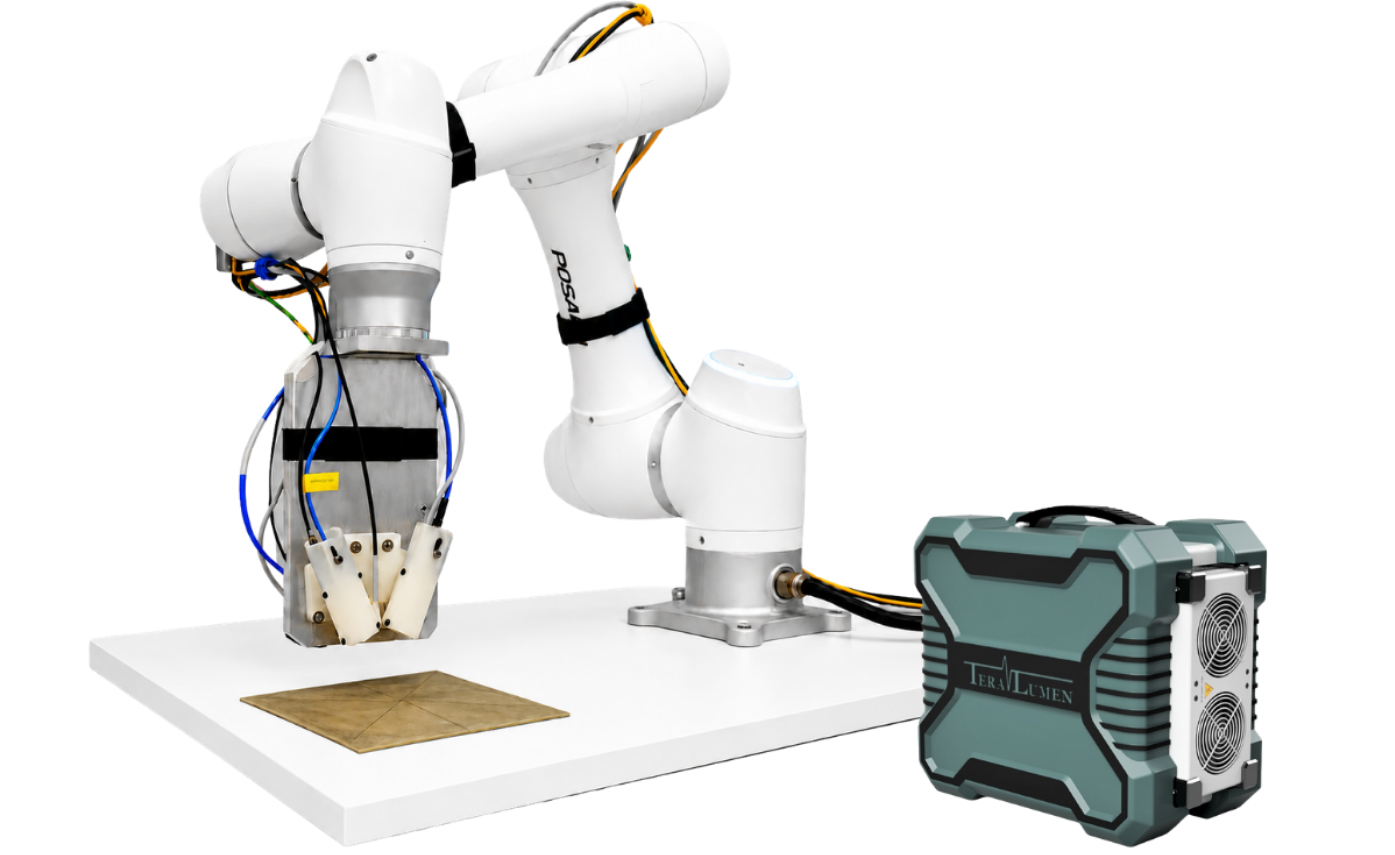
- Automation Ready – Integrates with scanners, robots and cobots.
- Industry 4.0 – Traceable digital inspection records.
Aerospace GFRP Quality Control with TeraNIM™
TeraNIM-Aero provides a non-contact and non-destructive approach for inspecting validated GFRP aerospace components. By combining THz reflection measurement, laminate-specific calibration, signal processing and automated scanning, the system can support GFRP thickness measurement, delamination detection, void and inclusion assessment, defect mapping and automated aerospace inspection.
System configuration
TeraNIM-Aero
Related Applications
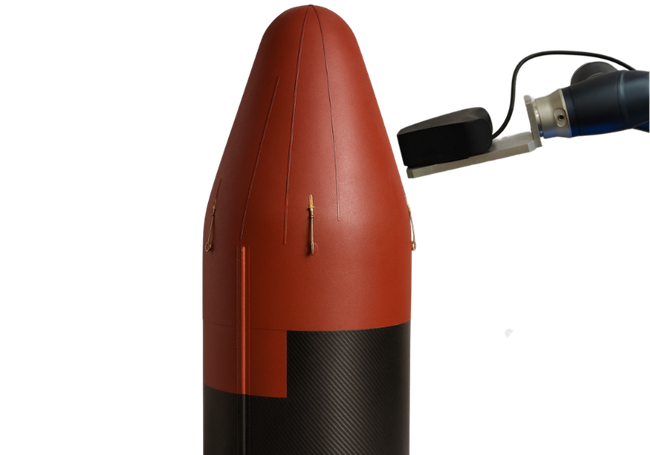
THz NDT on Red Rubber in Aerospace
Quality Control of Polymer-Based Rubber Components
Frequently Asked Questions
Can THz detect delamination inside GFRP?
Yes. THz-TDS has been demonstrated for detecting and imaging hidden delamination in GFRP laminates, including defects occurring at different depths within the stack.
Can TeraNIM-Aero measure GFRP thickness?
Yes, for suitable and calibrated GFRP structures. Reflected time-of-flight information gives laminate or layer thickness whenever the relevant interfaces can be distinguished. Recent work specifically demonstrates quantitative layer-thickness measurement in GFRP laminates.
What defects can be evaluated in GFRP?
Depending on material construction and defect characteristics, indications including delamination, voids, holes and foreign inclusions can be evaluated. The developing ISO work item for THz-TDS non-destructive testing of fibre-reinforced plastics identifies the same defect categories.
Does the THz probe need couplant?
No. THz inspection uses electromagnetic radiation and does not require the liquid coupling medium commonly associated with conventional contact ultrasonic inspection.
Can TeraNIM-Aero generate a GFRP defect map?
Yes. By scanning across the component, THz measurements can be converted into spatial inspection maps. Published work has demonstrated B-scan, C-scan and three-dimensional localisation approaches for GFRP delamination.
Can THz replace every conventional GFRP NDT method?
No. Inspection capability depends on laminate construction, thickness, resin system, defect depth, defect size and the required qualification standard. THz is particularly useful where non-contact inspection of dielectric composite structures, internal interfaces and thickness is required. Ultrasonic, X-ray/CT, thermography and other NDT techniques remain useful depending on the inspection requirement.
What is the best first deployment?
Start with a paid laboratory feasibility study on representative coupons, then a rental-based production validation cell, then purchase or in-line integration once the success criteria are met.