

TeraLumen Solutions

Terahertz Technology

 
THz food adulteration detection turmeric chalk powder

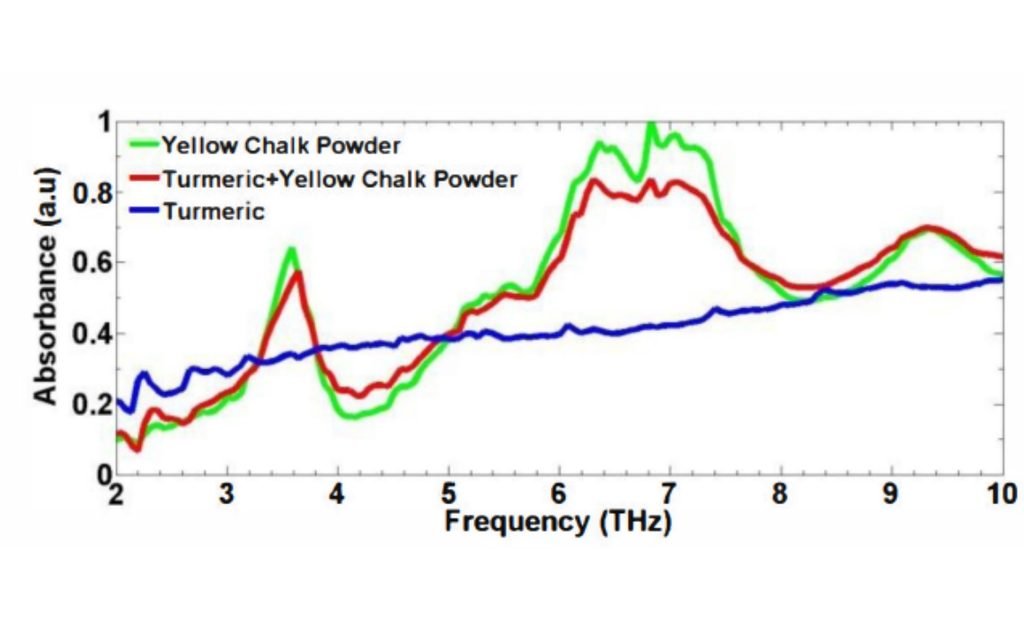
THz food adulteration detection is now possible through sealed packaging without opening or chemically treating the product. This study from CSIR-CEERI Chennai shows that chalk powder mixed with turmeric produces distinct THz absorption peaks at 3.6, 6.3, 7.0, and 9.3 THz—peaks completely absent in pure turmeric.

Critically, the study shows that absorbance at 6.3 THz scales linearly with adulterant concentration—meaning THz spectroscopy does not just detect adulteration, it quantifies it. Concentrations from 10% to 40% chalk powder were measured and distinguished with a simple linear calibration curve.

Why conventional methods fail—and why THz succeeds

Current food adulteration testing methods have serious limitations:

  • HCl effervescence test — qualitative only, cannot quantify the extent of adulteration, and requires opening and chemically treating the sample
  • NIR/mid-IR spectroscopy cannot penetrate common food packaging (paper, plastic), which absorbs strongly in this frequency range, making through-pack inspection impossible
  • Laboratory chemical analysis—time-consuming, destructive, requires trained personnel, and cannot be deployed at retail or distribution checkpoints

THz radiation overcomes all three limitations. Common food packaging materials (paper, polyethylene, plastic) are transparent in the THz range and produce no interfering resonances. A THz transceiver placed against a sealed package reads the absorption spectrum of the contents directly—fast, non-destructive, and without any sample preparation.

Methodology at a glance

  • Samples—turmeric mixed with yellow chalk powder (CaCO₃) at concentrations of 10%, 20%, 30%, and 40%; pellets prepared with 90% HDPE binder, 0.5 mm thick
  • Instrument—Nicolet 6700 FT-IR spectrometer (1.8–300 THz range), frequency resolution 0.06 THz, averaged over 36 scans
  • Quantification—absorbance at 6.3 THz (CaCO₃ signature) normalised using Beer-Lambert law for thickness variation; linear calibration curve fitted across four concentration points
  • Confirmation—experiment repeated with white chalk powder to confirm peaks originate from CaCO₃ and not from yellow dye—both produce identical THz signatures

Results summary

  • Pure turmeric shows no specific THz resonances between 2–10 THz—a flat, featureless baseline
  • Adulterated turmeric produces clear absorption peaks at 3.6, 6.3, 7.0, and 9.3 THz—all attributable to CaCO₃ in chalk powder
  • Linear quantification—absorbance at 6.3 THz increases linearly from 1.2 (10% chalk) to 2.04 (40% chalk), enabling reliable concentration estimation
  • Through-pack capability—THz penetrates common packaging, enabling non-intrusive in-situ inspection at warehouse, retail, or FSSAI checkpoint level

Broader applications in food and pharma quality control

The methodology demonstrated here—THz absorption fingerprinting + Beer-Lambert quantification—is directly transferable to other food adulteration scenarios where the adulterant has a THz signature:

  • Other spices — pepper, chili, and cumin adulterated with starch, sawdust, or mineral powders
  • Pharmaceutical powders—counterfeit drug identification and active ingredient verification in sealed tablet blister packs
  • Packaged food inspection—quality gate screening at FSSAI-regulated distribution and processing facilities

Read the complete IEEE conference paper, including spectral data, Beer-Lambert normalisation, and concentration calibration curves.

Looking to deploy THz spectroscopy for food quality inspection or pharmaceutical verification? Explore the TeraXplor product page—capable of broadband spectral measurement from 0.1 to 10 THz for laboratory and inline inspection applications.

Contact TeraLumen Solutions.