




Understanding Terahertz Waves: The Science, Applications & Technology
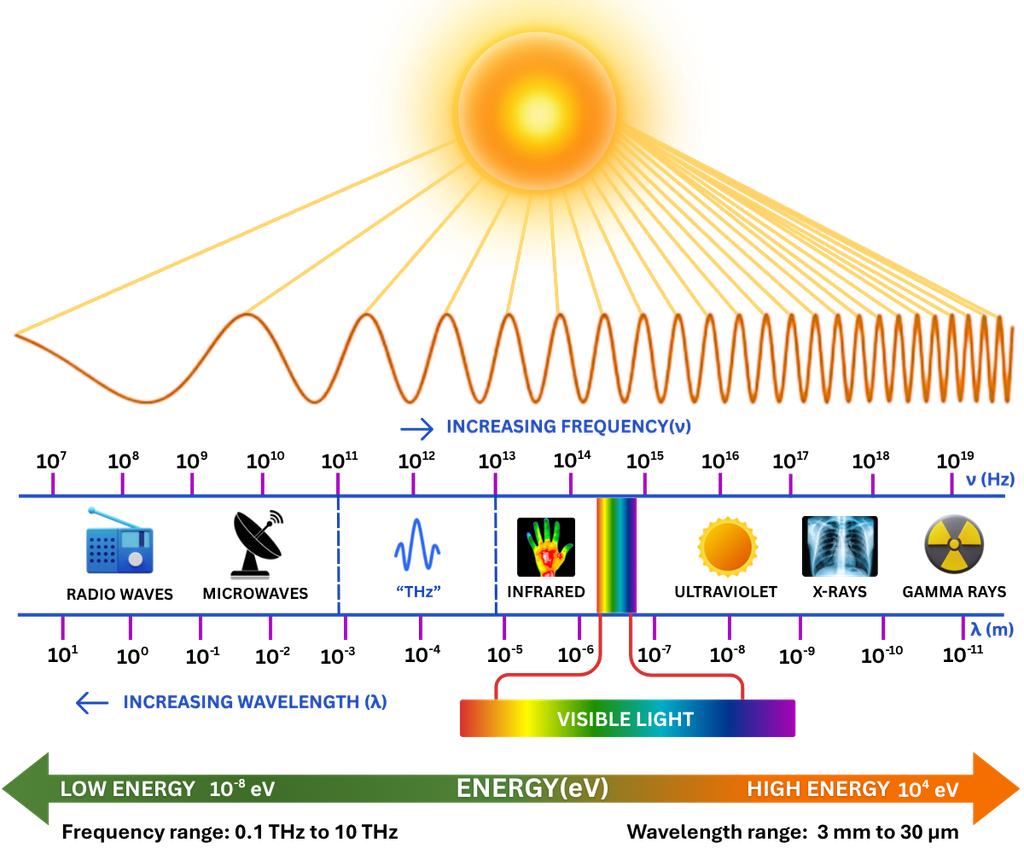
Abstract:Terahertz (THz) refers to the electromagnetic spectrum that lies between microwave and infrared light, spanning frequencies from approximately 0.1 to 10 THz. A terahertz wave has a wavelength ranging between 30 micrometres and 3 millimetres, characterized by its unique ability to penetrate various materials without causing damage or harm. This spectral region has garnered immense attention due to its combination of non-invasive properties and its ability to unveil hidden structural, chemical, and electronic information. Terahertz radiation is a relatively underexplored part of the electromagnetic spectrum. It occupies the frequency range between radio waves and infrared light, often referred to as the “terahertz gap” due to historical challenges in generating and detecting THz waves efficiently. Advances in ultrafast optics and semiconductor technology, enabled the development of terahertz systems that are now critical tools in scientific research and industrial applications.
Ready to apply terahertz technology to your measurement challenge? Explore the TeraXplor product page → or contact our application engineers.
Latest publications
- Ultra-Broadband Terahertz Flexible Meta-Absorber
- Role of structural asymmetry in tailoring electromagnetically induced transparency and figure of merit in terahertz metamaterials
- Understanding Terahertz Waves: The Science, Applications & Technology
- Identification of adulterants in turmeric powder using terahertz spectroscopy
- Design and Engineering of Organic Molecules for Customizable Terahertz Tags
- Terahertz Spectroscopy and Solid-State Density Functional Theory Calculations of Cyanobenzaldehyde Isomers
- Comparative Study of Hydration Kinetics of Cement and Tricalcium Silicate Using Terahertz Spectroscopy and Density Functional Theory Simulations