




Terahertz Spectroscopy and Solid-State Density Functional Theory Calculations of Cyanobenzaldehyde Isomers
Authors: Jyotirmayee Dash, Shaumik Ray, Kathirvel Nallappan, Vaibhav Kaware, Nitin Basutkar, Rajesh G. Gonnade, Ashootosh V. Ambade, Kavita Joshi, and Bala Pesala.
Published Online: June 16, 2015
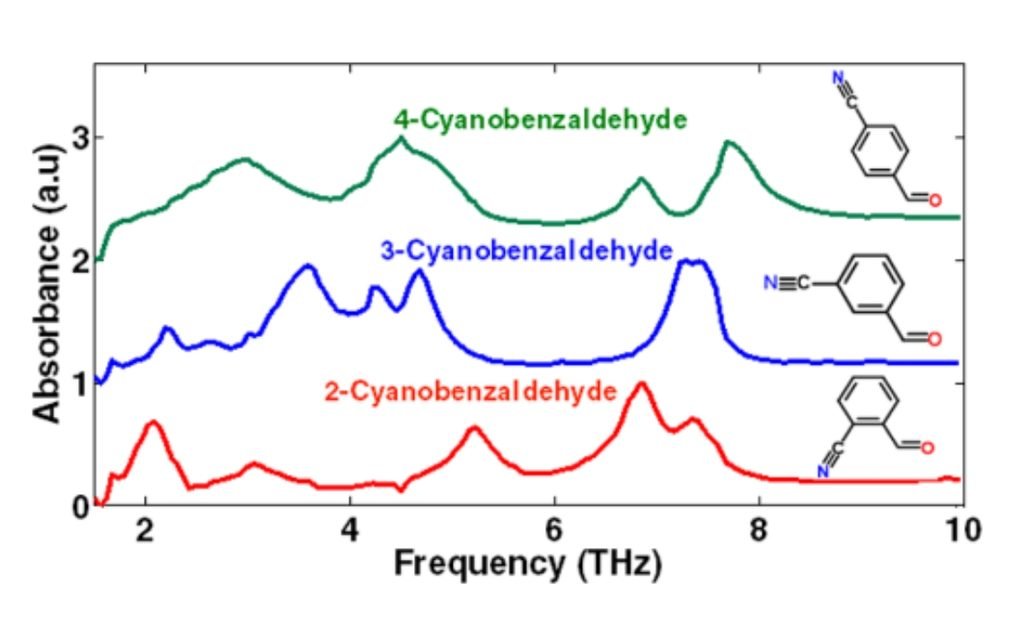
Abstract: Spectral signatures in the terahertz (THz) frequency region are mainly due to bulk vibrations of the molecules. These resonances are highly sensitive to the relative position of atoms in a molecule as well as the crystal packing arrangement. To understand the variation of THz resonances, THz spectra (2−10 THz) of three structural isomers: 2-, 3-, and 4-cyanobenzaldehyde have been studied. THz spectra obtained from Fourier transform infrared (FTIR) spectrometry of these isomers show that the resonances are distinctly different especially below 5 THz. For understanding the intermolecular interactions due to hydrogen bonds, four molecule cluster simulations of each of the isomers have been carried out using the B3LYP density functional with the 6-31G(d,p) basis set in Gaussian09 software and the compliance constants are obtained. However, to understand the exact reason behind the observed resonances, simulation of each isomer considering the full crystal structure is essential. The crystal structure of each isomer has been determined using X-ray diffraction (XRD) analysis for carrying out crystal structure simulations. Density functional theory (DFT) simulations using CRYSTAL14 software, utilizing the hybrid density functional B3LYP, have been carried out to understand the vibrational modes. The bond lengths and bond angles from the optimized structures are compared with the XRD results in terms of root-meansquare-deviation (RMSD) values. Very low RMSD values confirm the overall accuracy of the results. The simulations are able to predict most of the spectral features exhibited by the isomers. The results show that low frequency modes (<3 THz) are mediated through hydrogen bonds and are dominated by intermolecular vibrations.
Disclaimer: Full THz spectra, XRD crystal structures, DFT simulation results, compliance constant data, and vibrational mode assignments are in the published paper: Journal of Physical Chemistry A, 2015.
Contact TeraLumen Solutions → | TeraXplor product page →
Latest publications
- Ultra-Broadband Terahertz Flexible Meta-Absorber
- Role of structural asymmetry in tailoring electromagnetically induced transparency and figure of merit in terahertz metamaterials
- Understanding Terahertz Waves: The Science, Applications & Technology
- Identification of adulterants in turmeric powder using terahertz spectroscopy
- Design and Engineering of Organic Molecules for Customizable Terahertz Tags
- Terahertz Spectroscopy and Solid-State Density Functional Theory Calculations of Cyanobenzaldehyde Isomers
- Comparative Study of Hydration Kinetics of Cement and Tricalcium Silicate Using Terahertz Spectroscopy and Density Functional Theory Simulations