




Tuning of Terahertz Resonances of Pyridyl Benzamide Derivatives by Electronegative Atom Substitution
Authors: Jyotirmayee Dash, Shaumik Ray, Nirmala Devi, Nitin Basutkar, Rajesh G. Gonnade, Ashootosh V. Ambade, and Bala Pesala.
Published Online: 18 May 2018
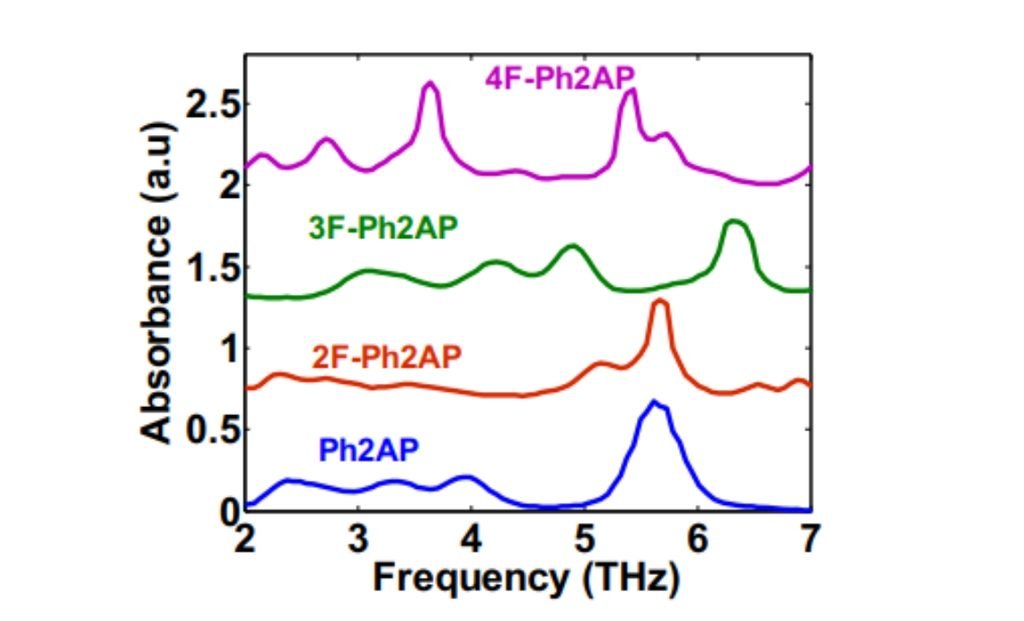
Abstract: N-(pyridin-2-yl) benzamide (Ph2AP)-based organic molecules with prominent terahertz (THz) signatures (less than 5 THz) have been synthesized. The THz resonances are tuned by substituting the most electronegative atom, fluorine, at ortho (2F-Ph2AP), meta (3F-Ph2AP), and para (4F-Ph2AP) positions in a Ph2AP molecule. Substitution of fluorine helps in varying the charge distribution of the atoms forming hydrogen bond and hence strength of the hydrogen bond is varied which helps in tuning the THz resonances. The tuning of lower THz resonances of 2FPh2AP, 3F-Ph2AP, and 4F-Ph2AP has been explained in terms of compliance constant (relaxed force constant). Four-molecule cluster simulations have been carried out using Gaussian09 software to calculate the compliance constant of the hydrogen bonds. Crystal structure simulations of the above molecules using CRYSTAL14 software have been carried out to understand the origin of THz resonances. It has been observed that THz resonances are shifted to higher frequencies with stronger hydrogen bonds. The study shows that 3F-Ph2AP and 4F-Ph2AP have higher hydrogen bond strength and hence the THz resonances originating due to stretching of intermolecular hydrogen bonds have been shifted to higher frequencies compared to 2F-Ph2AP. The methodology presented here will help in designing novel organic molecules by substituting various electronegative atoms in order to achieve prominent THz resonances
Disclaimer: The full paper includes synthesis methods, THz-TDS and FTIR spectra, compliance constant tables, DFT simulation results, and crystal structure data. It is published in the Journal of Infrared, Millimeter, and Terahertz Waves, 2018.
Latest publications
- Ultra-Broadband Terahertz Flexible Meta-Absorber
- Role of structural asymmetry in tailoring electromagnetically induced transparency and figure of merit in terahertz metamaterials
- Understanding Terahertz Waves: The Science, Applications & Technology
- Identification of adulterants in turmeric powder using terahertz spectroscopy
- Design and Engineering of Organic Molecules for Customizable Terahertz Tags
- Terahertz Spectroscopy and Solid-State Density Functional Theory Calculations of Cyanobenzaldehyde Isomers
- Comparative Study of Hydration Kinetics of Cement and Tricalcium Silicate Using Terahertz Spectroscopy and Density Functional Theory Simulations