




Design and Engineering of Organic Molecules for Customizable Terahertz Tags
Authors: Kathirvel Nallappana, Jyotirmayee Dash, Shaumik Ray and Vaibhav Kaware.
Published Online: February 2014
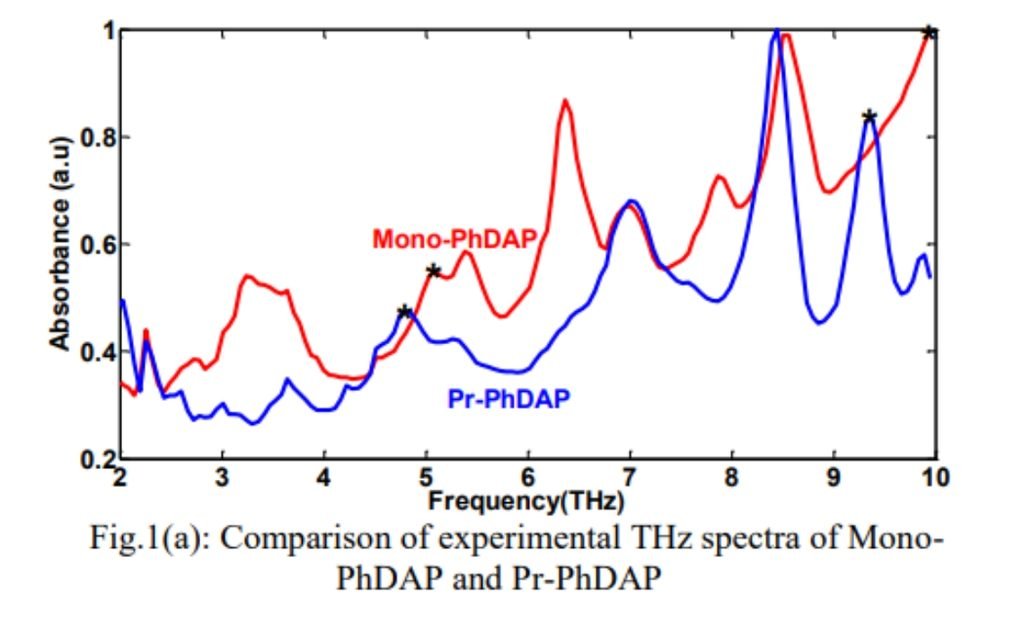
Abstract: Terahertz (THz) frequency band lies between the microwave and infrared region of the electromagnetic spectrum. Molecules having strong resonances in this frequency range are ideal for realizing “Terahertz tags” which can be easily incorporated into various materials. THz spectroscopy of molecules, especially at frequencies below 10 THz, provides valuable information on the low frequency vibrational modes, viz. intermolecular vibrational modes, hydrogen bond stretching, torsional vibrations in several chemical and biological compounds. So far there have been very few attempts to engineer molecules which can demonstrate customizable resonances in the THz frequency region. In this paper, Diamidopyridine (DAP) based molecules are used as a model system to demonstrate engineering of THz resonances (< 10 THz) by fine-tuning the molecular mass and bond strengths. Density Functional Theory (DFT) simulations have been carried out to explain the origin of THz resonances and factors contributing to the shift in resonances due to the addition of various functional groups. The design approach presented here can be easily extended to engineer various organic molecules suitable for THz tags application.
Want to explore THz molecular tag technology for your application?
Connect with the TeraXplor team: TeraXplor product page → | Contact TeraLumen Solutions →
Latest publications
- Ultra-Broadband Terahertz Flexible Meta-Absorber
- Role of structural asymmetry in tailoring electromagnetically induced transparency and figure of merit in terahertz metamaterials
- Understanding Terahertz Waves: The Science, Applications & Technology
- Identification of adulterants in turmeric powder using terahertz spectroscopy
- Design and Engineering of Organic Molecules for Customizable Terahertz Tags
- Terahertz Spectroscopy and Solid-State Density Functional Theory Calculations of Cyanobenzaldehyde Isomers
- Comparative Study of Hydration Kinetics of Cement and Tricalcium Silicate Using Terahertz Spectroscopy and Density Functional Theory Simulations