




Comparative Study of Hydration Kinetics of Cement and Tricalcium Silicate Using Terahertz Spectroscopy and Density Functional Theory Simulations
Authors: Shaumik Ray, Jyotirmayee Dash, Nirmala Devi, Saptarshi Sasmal, and Bala Pesala.
Published Online: 18 May 2018
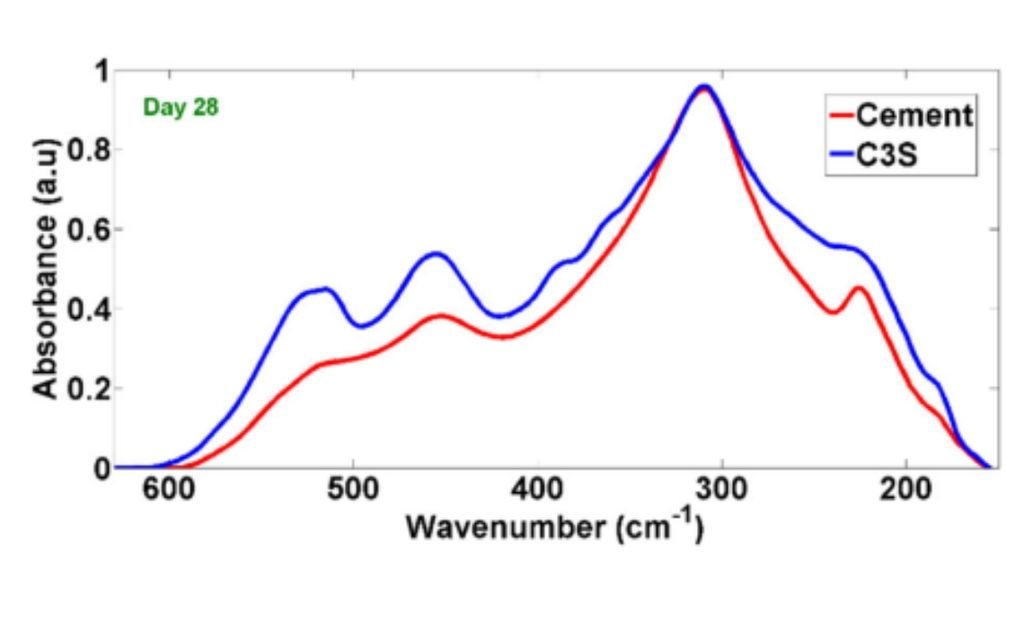
Abstract: Cement hydration is a process involving simultaneous reactions of cement constituents, primarily tricalcium silicate (C3S) and dicalcium silicate (C2S), with the formation of key hydration products, calcium silicate hydrate (C–S–H) and calcium hydroxide (Ca(OH)2 ). Compared to the conventionally explored mid-infrared spectroscopy which is bond specific, terahertz (THz) spectroscopy is highly sensitive to crystalline arrangements and resonances in THz frequency range are primarily due to bulk vibrational modes. Hence, THz spectroscopy can be an effective complimentary tool to study the hydration process as C3S gets converted to different polymorphs of C–S–H. To understand the origin and variation of THz resonances of C3S, C–S–H polymorphs and Ca(OH)2, vibrational modes of C3S, tobemorite 9, tobermorite 14, jennite, and portlandite have been calculated using density functional theory simulations. The origin of the main resonances has been studied using vibrational density of states. Simulations show, for C3S, the resonance around 520 cm−1 appears due to combined effect of symmetric and asymmetric vibrations in SiO4 tetrahedra, the resonance around 450 cm−1 appears due to the combined effect of symmetric and asymmetric SiO4 tetrahedra, and CaO vibrations and the resonance around 318 cm−1 is primarily due to CaO vibrations. THz spectroscopy has been performed to track and understand the contribution of C3S in cement hydration. By combining the simulation and experiments, this work clearly explains the reduction of 520 cm−1 resonance, the constant intensity of 450 cm−1 resonance and frequency shift of the main resonances as C3S is transformed into various polymorphs of C–S–H during hydration
Full THz spectra, DFT simulation data, 28-day hydration tracking, and comparative cement vs C3S analysis are in the published paper: Journal of Infrared, Millimeter, and Terahertz Waves, 2018.
Latest publications
- Ultra-Broadband Terahertz Flexible Meta-Absorber
- Role of structural asymmetry in tailoring electromagnetically induced transparency and figure of merit in terahertz metamaterials
- Understanding Terahertz Waves: The Science, Applications & Technology
- Identification of adulterants in turmeric powder using terahertz spectroscopy
- Design and Engineering of Organic Molecules for Customizable Terahertz Tags
- Terahertz Spectroscopy and Solid-State Density Functional Theory Calculations of Cyanobenzaldehyde Isomers
- Comparative Study of Hydration Kinetics of Cement and Tricalcium Silicate Using Terahertz Spectroscopy and Density Functional Theory Simulations