




Ultra-Broadband Terahertz Flexible Meta-Absorber
Authors: Bhawana Andola, Sangram Kumar Sadhu, Thasleena Kandan Parambil, Sutopa Modak, Priyanka Dewangan, Vanlal Rinfela, Md Arsalan Ashraf, Manoj Gupta, Prem Pal, Abhishek Kumar, Yogesh Kumar Srivastava
First published: 20 August 2026
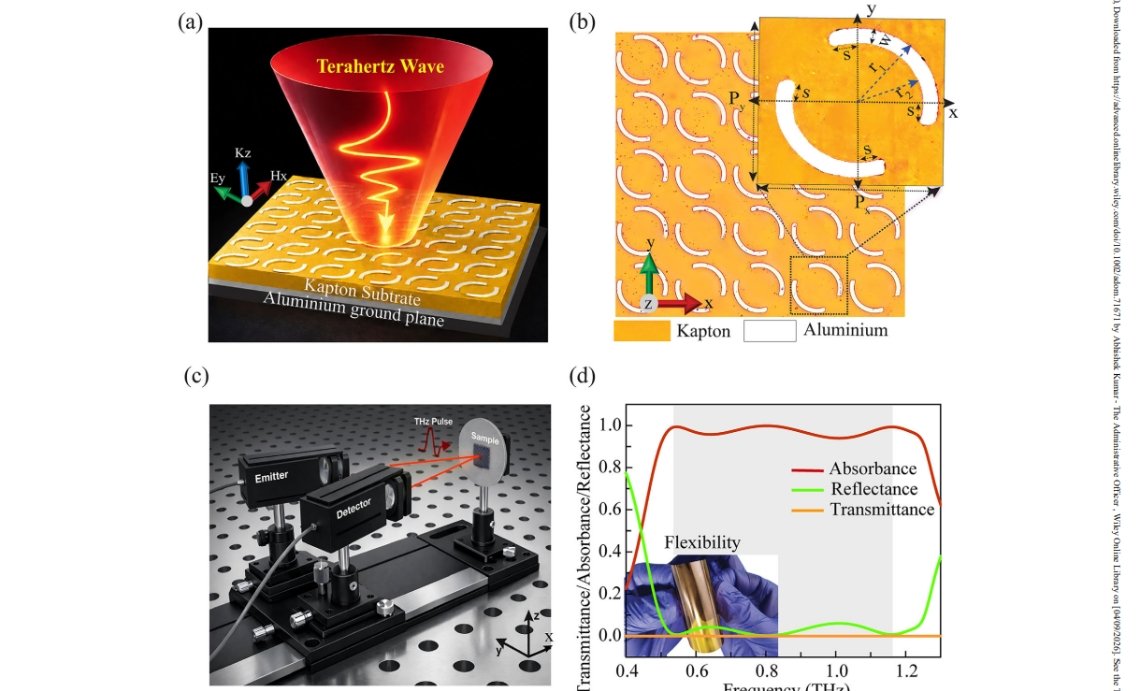
Abstract: Terahertz (THz) metasurface absorbers have emerged as a promising platform for electromagnetic wave manipulation owing to their compact footprint, structural versatility, strong light-matter interaction, and near-unity absorbance, enabling applications in sensing, imaging, stealth technology, and wireless communications. However, simultaneously achieving ultra-broadband absorbance, mechanical flexibility, angular stability, and active tunability within a single metasurface platform remains challenging, and often requires complex designs and fabrication processes. Here, we experimentally demonstrate an ultra-broadband THz meta-absorber based on a metal-dielectric-metal (MDM) architecture employing a structurally simple arc-shaped aluminium structure integrated on a flexible Kapton substrate. The fabricated device exhibits experimentally measured broadband absorbance exceeding 90% over the broad frequency range of 0.54–1.10 THz. Furthermore, the absorber maintains excellent performance under different bending curvatures and oblique incidence, demonstrating outstanding mechanical robustness and angular stability, making it compatible for integration with curved surfaces. Numerical investigations further reveal efficient thermal tunability through the integration of phase-change material vanadium dioxide (VO2). Our proposed flexible meta-absorber combines ultra-broadband absorbance, mechanical robustness, angular stability, and active tunability within a compact and fabrication-friendly platform, making it a promising candidate for next-generation THz sensing, imaging, stealth technology, wireless communications, and adaptive photonic devices.
Disclaimer: Thank you for publishing your research using the TeraLumen-TeraXplor system
Latest publications
- Ultra-Broadband Terahertz Flexible Meta-Absorber
- Role of structural asymmetry in tailoring electromagnetically induced transparency and figure of merit in terahertz metamaterials
- Understanding Terahertz Waves: The Science, Applications & Technology
- Identification of adulterants in turmeric powder using terahertz spectroscopy
- Design and Engineering of Organic Molecules for Customizable Terahertz Tags
- Terahertz Spectroscopy and Solid-State Density Functional Theory Calculations of Cyanobenzaldehyde Isomers
- Comparative Study of Hydration Kinetics of Cement and Tricalcium Silicate Using Terahertz Spectroscopy and Density Functional Theory Simulations